A weblog by Tom Coates concerning future media, social software and the web of data
Quote of the month: "This is not a brothel, there are no prostitutes here"
You can explore the archives, read the disclaimer or subscribe to an RSS feed

Discussion and Citation in the Blogosphere...

Posted May 25, 2003 12:51 PM.

A few days ago a stunningly interesting article was published on Microdoc News called Dynamics of a Blogosphere Story which aimed to look at exactly how a story or discussion moved through weblog space. I've been thinking along similar lines for a while now - at least partly as a way of articulating my problems with the iWire Scaling Clay Shirky piece. I've been trying to put down on paper why I think the iWire assertions are incorrect and to develop an alternative model of how discussion can occur usefully through the 'blogosphere'. In fact more than that - I wanted to illustrate why I believe the system works to actually generate better discussion than a simple discussion board - by (on average) helping to hide the bad content and making it easier to find the good content. I most recently wrote something that gestured in this direction (How do we find information in the blogosphere?)

The Microdoc News piece is particularly illuminating because it's dragged some actual examples into the fray. After examining 45 "blogosphere stories" they found four kinds of posts and a relatively predictable pattern of their usage, with an initial weighty post generating an explosion of smaller fragmentary reactions, commentaries and votes (cf Casting the microcontent vote). These posts are then aggregated or collected into another weighty post, which itself might have the potential to push forward the debate. Their four example posts are:

  1. Lengthy opinion and molding of a topic around between three to fifteen links with one of those links the instigator of the story;
  2. Vote post where the blogger agrees or disagrees with a post on another site;
  3. Reaction post where a blogger provide her/his personal reaction to a single post on another site;
  4. Summation post where the blogger provide a summary of various blogs and perspectives of where a blog story has got to by now.

I've been working in similar directions as this - in an attempt to resolve the questions, "Can you have good discussion across the blogosphere?", "What is the nature of that discussion?" and "How does it differ from message-board conversation?". And I think the answer lies - yet again - in going back to the beginning and looking at the way the web in general (and weblogs in particular) operate like an academic citation network.

The origins of the web are highly academic in origin. So it's hardly a surprise that the combined use of hypertext and discreet blocks of content comes to mirror academic citation in research papers. Apart from a few wry-eyebrow-raising academics, I think most of us would agree that the idea that useful debate cannot happen in academic discourse is patently absurd. After all, the vast bulk of academic research in both the humanities and sciences is published as part of an ongoing conversation involving statements and citations.

The weblog sphere has taken on a great many of the characteristics of the distributed academic community's citation networks - just at a much smaller, faster and more amateur level. Consensus can emerge (briefly or otherwise), reputations are made (deservedly or not), arguments occur regularly (usefully or otherwise). Nonetheless, discussions do occur, they do progress and they do reach conclusions. But it's happening at a granularity of paragraphs rather than articles. It's happening at a scale of hours rather than months.

The Microdoc article could easily have been written about citation networks in academic literature. And when we realise this, then lots of other things become clear too. The answers to my earlier questions are beginning to come into focus. And they remain basically simple answers too:

  • "Can you have good discussion across the blogosphere?"
    There are clear analogues for the way discussion over the blogosphere operates. One of those is academic / scientific discourse. This suggests (although it doesn't prove) that not only can we have good discussion over the blogosphere, that it was almost optimised in such a way to make it inevitable.
  • "What is the nature of that discussion?"
    Perhaps we can answer that now by comparing the Microdoc article with studies of academic discourse like Kuhn's Paradigm Shifts.
  • "How does it differ from message-board conversation?"
    If we know what the answer to the previous question is, then maybe we can answer this one by a simple direct comparison.

So here's my suggestion of how we can usefully conceive of discussion occurring across the blogosphere (and I think it's a model that's practically explicit in the Microdoc article, so forgive me if it's boring). We should think of it as a kind of micro-paradigm shift - a kind of hyperactive academia, where discussion moves forward in discontinuous chunks - with an initial weighty post articulating a position that is then commented upon, challenged and cited all over the place. But the debate doesn't move forward until someone manages to articulate a position of sufficient weight and resonance to shift the emphasis of the discussion to their new position.

The weight of these debate-structuring posts can often be measured in terms of aggregated insight - in which case it's a purely progressive model - an individual synthesizes all the interesting comments made by everyone else and pushes it slightly further, generating a new baseline from which the conversation can continue. On occasion, however, it would still be possible that an individual's reputation would be weighty enough that everything they say defines the scope of the debate - that smaller dissenting voices would not be heard - and the debate would be carried behind a leader of some kind. And of course there are the times where a debate fragments or polarises, where more than one of these structuring posts occurs roughly simultaneously, or with radically different views - bifurcating any debate. Nonetheless, debate remains a series of discontinuous leaps, structured by impactful posting.

Here's a diagram that I think illustrates how I think discussion happens between weblogs:
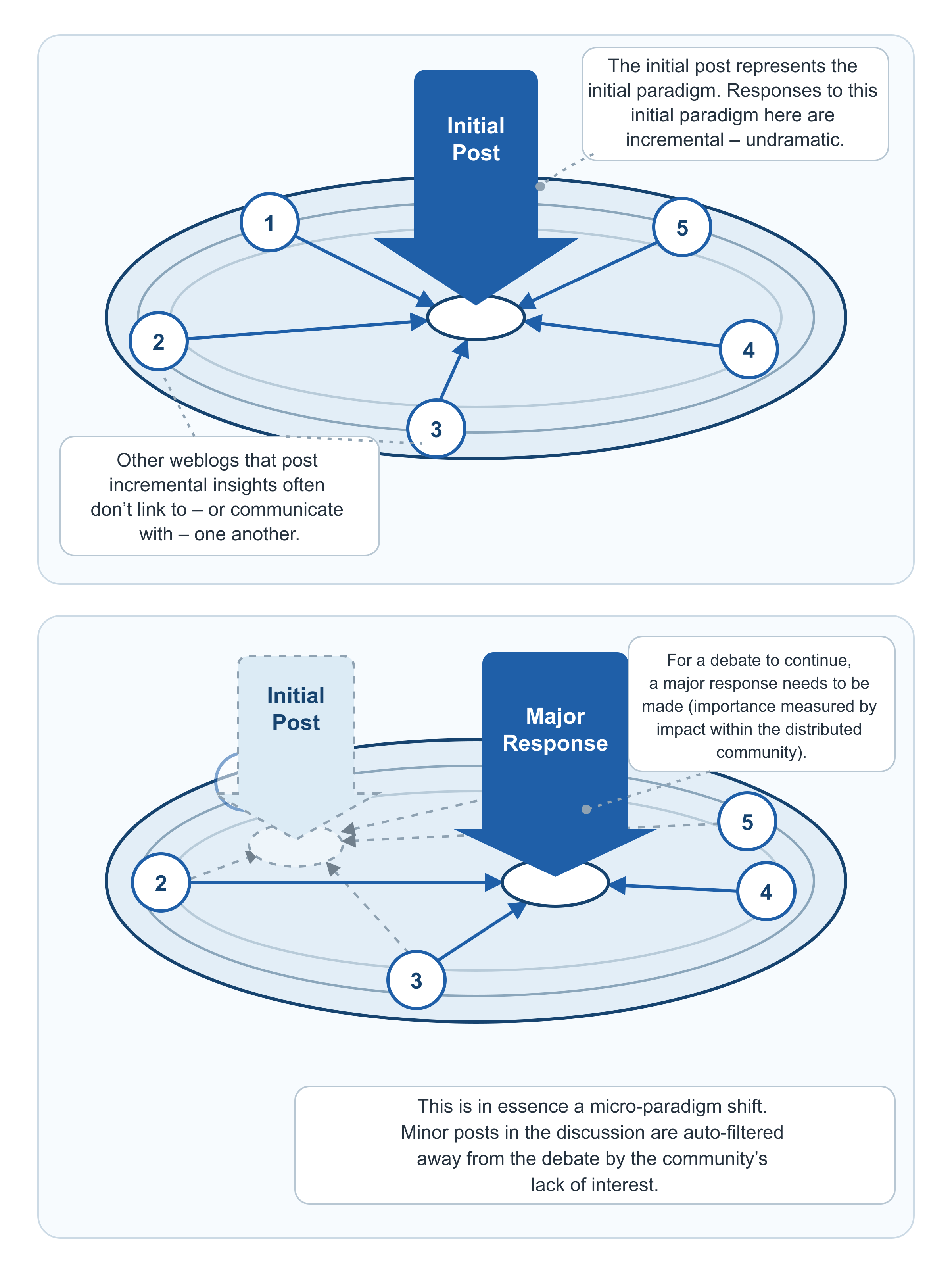
This ties in well with my previous article on finding information in the blogosphere. Because the smaller posts with negligible insight, voting or replicated insight are less likely to be linked to, then they're also less likely to be read. And yet their value remains - they represent the arbiters (in a distributed fashion) of what should be being read. The posts that one is directed to most quickly are these structural posts - places where some kind of micro-paradigm shift has occurred.

I'm going to end now with a bit of a brief discussion about the differences between this kind of debate and the kinds of discussion that one finds on message-boards. I'm going to start off with a comparative diagram:
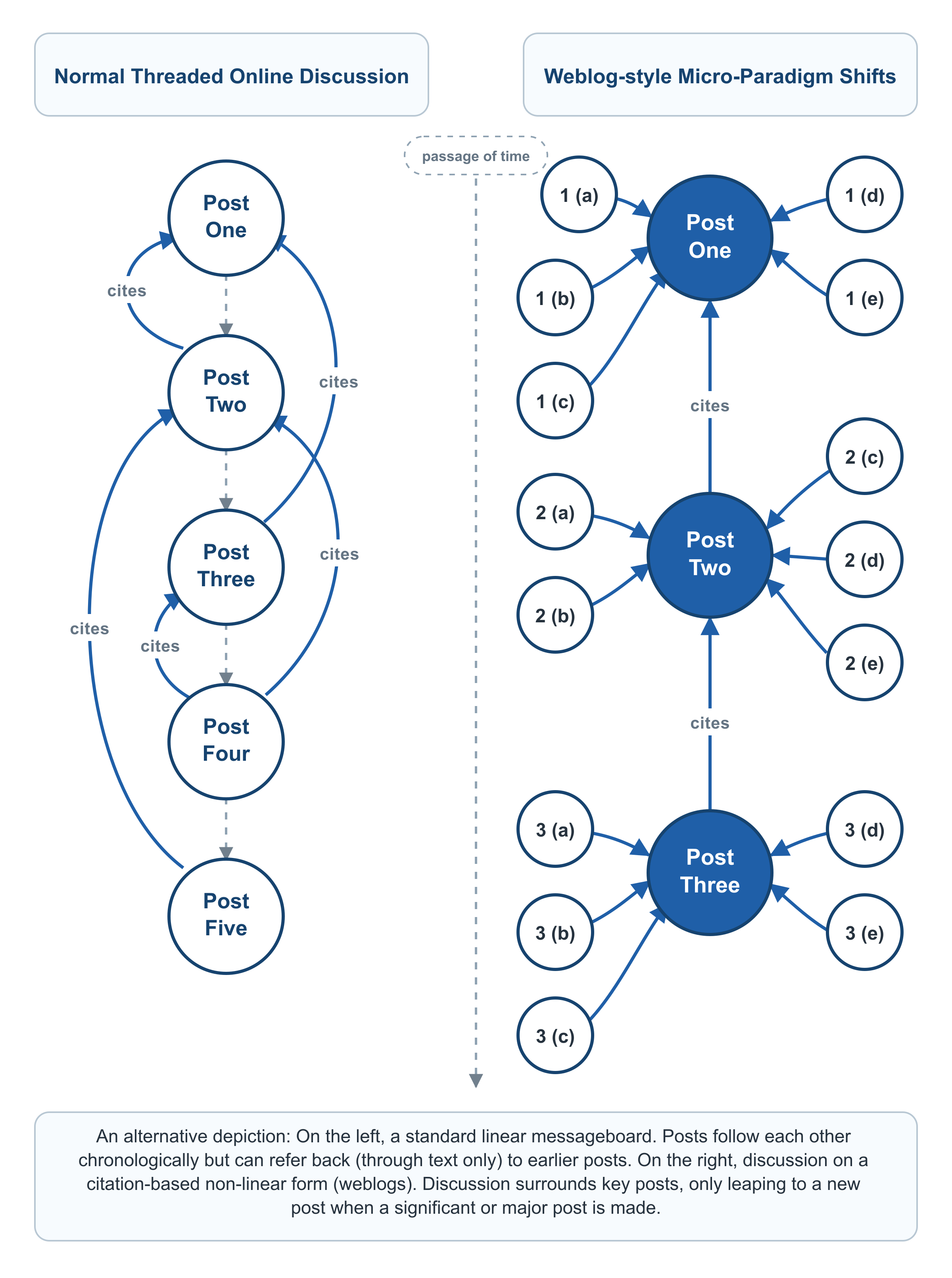
On the left, you can see a normal piece of discussion - as it would occur on a threaded message-board. In this example, the top post is the first, the second post cites the first, the third also cites the first while the fourth cites both the third and the second but not the first. In this debate there is no filtering mechanism of any kind. If the second post is entirely off-topic or contains spurious information, then it remains very clearly in the context of the thread. And if that thread is linked to from elsewhere, there can be no simple evaluation of what posts are considered more worthwhile than other1 - the thread is either good or it is not.

On the right, you can see a simplified diagram of the passage of a discussion through a citation network. If there are filtering mechanisms functioning through the community (in our case people choose who to link to based on whatever personal preference they wish to express) then the most important structural posts will self-locate towards the middle, generating a clear (almost linear) movement of discussion from first principles towards a conclusion of some kind. The conclusion itself may never be met - consensus may never be fully reached - but positions with regard to this evolving dominant narrative will be reached by everyone. Those posts which are merely "I agree" or "I disagree" will be filtered from the public consciousness, even as they have fulfilled a valuable function in directing people towards the next structural post in their debate.

So - what does this all mean? In essence I'm arguing that debate across weblogs self-organises in a pretty useful way. But I'm not going to pretend that it operates perfectly or that we can't do anything to improve it. However, it seems to me that rather than bemoaning the things that make debate across weblogs different, we should be trying to grease the wheels of those mechanisms. It's my personal belief (and one that I've expressed before) that things like trackback and Daypop work so well because they are specifically building upon - enhancing - the mechanisms that make webloggia operate effectively in the first place. If you're looking for more specific suggestions, then I think that a balkanisation of blogdex would help different those mechanisms work more effectively within smaller communities with different and more distinct interests. After that, I have no idea. That's where you people come in...

Footnote: (1) Obviously Slashdot has made gestural moves in this direction, but there are some interesting differences between the way the distributed community of webloggers evaluate one another and the way it is handled on Slashdot.

Comments

Please stay on-topic, informative and polite. I reserve the right to remove comments for whatever vague capricious reasons seem reasonable at the time.

I'd just like to apologise to everyone for bashing out such a large piece and then not proof-reading it before putting it online. If I notice any errors I've made, I'll correct them later in the day. If they're substantial, I'll point them out in the comments...

Posted by: Tom Coates at May 25, 2003 1:32 PM

Scientific or academic discussions are 'usually' based upon research that has gone through a process of peer review. There are a few examples where this has been flawed, but the peer review process is a rigorous criteria for a discussion. Blogs are self-edited, in the majority of cases, but can still make or state policy or opinion. In that sense, the discussions you talk about are similar to the actions of political think-tanks. The discussion of an idea leads to the experiment.

Posted by: Gummi at May 25, 2003 1:47 PM

Yes - there are clearly some differences between the way people publish on weblogs and the way in which papers are published. One obvious difference would be that most people who publish in the academic sphere are a priori going to be experts of a certain level. But in a sense these don't create significant problems - peer review is still undertaken in weblogging, albeit at a later stage. Who you link to or choose not to link to, which articles you find interesting or are within your expertise - these constitute a form of peer review, as indeed does the presence of occasional experts who can more easily write the next structuring post - a post that could demolish your arguments systematically, and would be inevitably be linked to by people interested in the same subject.

   I suppose what I'd be arguing here is not that the parallels are exact but that they are illuminating and "good to think with".

Posted by: Tom Coates at May 25, 2003 1:58 PM

Sorry - additional stuff - the think tank stuff is really interesting. Thanks for adding that. The other thing I wanted to point out to the world at general is that just because there is a barrier to entry in academic circles doesn't mean that all academics are equally good or that they all contribute something useful to the debates they participate in. We all know that this is not the case - the question is, given a block of people commenting on the same thing, will some of their work be considered better than others, get read more and end up being structural parts of the debate as a whole. I would argue that this clearly happens and that the same mechanisms work for weblogs, only with a much larger sample group of varying abilities and insights...

Posted by: Tom Coates at May 25, 2003 2:03 PM

The idea that webloggers, by linking and comments, are in effect reviewing the publication of that view or opinion is warranted. A person or organisation can publish a body of work and be prolific, but if they're not cited in the wider sphere of what they're trying to influence or comment upon, then the idea exists but is not popular - the idea itself may be without merit and is an additional subclass, there are lots of bad conclusions published in science but rarely bad data (unless it's fabricated or reviewed in a incestuous way).

The problem lies in what the opinion hopes to do, once it's published the idea falls or dies by linking. This doesn't necessarily mean the idea is badly thought out or wrong. There is an abundance of scientific work which goes completely ignored but adds to a critical mass of 'data'; in pure research this may go unnoticed, eventually that work is acknowledged and subsequently, decades after the fact, it's capitalised upon. In the websphere this information is effectively lost because a Google-like repository only responds to links which have been made to the article, reciprocity makes a big difference here. In science, you not only deal with the peer review but the repository is openly available and never fluctuates. The publications are static.

The think-tank analogy is important, even in that case, thoughts and views have to published in a centralised, freely available manner. Additionally, a brain-trust only appeals to people who think the ideas resonate with their own. This adds another layer of filtering which can stifle open debate.

I look upon weblog opinion as influential in the realms of web technology and content management systems - I don't wish to denegrate other categories by their absence, I'm sure my opinion on those isn't interesting.
In essence, since there's no weekly Journal of Web Technology, blogs (could) help to fill that void. Even though the review system you outline is severely limited to the number of people who can see the content - internet, computer, time etc. - the biggest hurdle is to find the weblog and hope the latest entry has something worth saying to you. I do hope this all makes sense in some way :)

Posted by: Gummi at May 25, 2003 4:01 PM

Thanks for the diagrams and the great piece... I have been working my way through this one and your posting really helped...

Posted by: susan mernit at May 25, 2003 4:19 PM

You've got to stay off the OmniGraffle, man, it's like, *crack*.

Posted by: jebni at May 26, 2003 1:16 AM

Bravo.

I would comment further here, but its a discussion board. I'll save people time and rely on a blog post to be filtered for importance.

http://www.corante.com/many/20030501.shtml#36644

Posted by: Ross Mayfield at May 26, 2003 10:35 PM

Interesting thoughts Tom.

You might want to check the comments to a post on (of all things) Matrix Reloaded, over at Kottke's.
What I think is peculiar is that your considerations still perfectly apply: if you take the time to read through all 260+ (and counting) contributions you'll encounter the very same patterns you describe.
An original interpretation of the movie (main post), echoed by another similar one (major response), followed by scattered chatter (micro-votes), collected in a weighty post (aggregator) and so on.

Even more fascinating is that over time hubs (thought leaders) have clearly emerged ("Spoon Boy", "Brian"), with other strong voices taking the debate further and the rest adding random thoughts to the conversation.

Jason has seemingly decided to "relinquish control" in this case, and the child space has taken a life of his own, inheriting implicit rules from its parent.
Clay Shirky and object-oriented programming fans should be proud.

A fascinating fractal-like case of scale-invariance, the micro mimicking the macro?
Or simply an ecosystem starting to show its underlying patterns?

Posted by: fabio at May 28, 2003 9:12 AM

Thanks Fabio! This actually reminds me - I've been waiting now for someone to write up a piece on, "The Matrix as Social Software" and no one has! It's either going to be a satire or a biting critique, I think, but I'm really surprised no one has done it yet...

Posted by: Tom Coates at May 28, 2003 9:27 AM

Steven Downes OL Daily provided the link to your comments on discussions in the blogosphere - I found your use of graphics very helpful - supporting the view that good diagramatics help deliver a message with more impact - especially if the graphics can depict the "passage" of the discussion from initial post to final summary and serve as a map for late comers who would like to catch up quickly.

Have you thought of leading with diagrams or other graphics to gain earlier understanding of the context of your remarks and your point of view on other subjects - or possibly using a well-designed set of graphics as a map to the whole subect of blog-based discussions?

Posted by: dave davison at May 29, 2003 12:52 AM

Thanks for the thinking and sharing, Tom. (And I second Dave's comments about the visuals, though I would suggest there are many other patterns in discussion board conversations!)

What do you think are the facilitative aspects of conversations propagated through blogs - either intentional or "accidental?" For example, you mention summarization (which I would consider a facilitative action). Fabio suggests that the facilitative action can be moved through the group. Your thoughts? (I say this as a person interested in facilitative aspects of online communication, either by a "facilitator" or by a group itself.)

THANKS!

Posted by: Nancy White at May 29, 2003 4:34 AM

We're experimenting widely with blogs in academe @ Middlebury College.

What you say, Tom, makes a lot of sense to me, particularly since we have students creating their own blogs (http://manila.cet.middlebury.edu/introcreativewriti/stories/storyReader$20), but really only discuss ideas and topics on the "motherBlog," if you will. This lends itself more to the traditional threaded discussion which you so keenly represent, above.

We're going to try and move to a more "blogCentric" model, again as you diagram above. We're running a very interesting course on Irish Literature and Film this Fall ('03), so we'll try it there and see how we manage.

Thanks for the valuable insights!

Posted by: hector vila at May 29, 2003 3:52 PM

Tom and all,
Thanks for the interesting post and ensuing discussion. I too think there is merit in the idea that blogs can create valuable discussion.

Here's one way I think about it...

I can see the blogosphere as a big online community/message board that is made up of self-managing interest groups. The members may not have the insular relationships that are built inside communities, but the context of discussions between bloggers can be even more rich.

Unlike most message board users, bloggers consistently link to their blog as their "profile". This enables a particpant to find much more personal context in discussion by having quick access to each participant's blog site- which can be a very personal experience.

I think that a blog working as a "profile" can add something special to blogosphere discussions by giving each blogger a rich representation of themselves and context to their posts.

Posted by: Lee at May 29, 2003 5:36 PM

Much food for thought, as ever, Tom. A couple of points:

What if there are no paradigm shifts? An example would be Where is Raed? for which there tended to be only one comment... "It's marvellous, go see." Might this evolve in more of a "daisy-fractal" than your "linear-with-petals" suggestion?

Secondly: No disrespect intended, but Mr Kottke's commentary on Matrix Reloaded is hardly earth-shattering. Yet it currently has over 400 comments. The reason for that huge (in blog-terms) response owes nothing to the original commentary, but everything to the large pre-existing readership, imo.

It's acting not as a "blog-with comments" so much as a straighforward message board.

Posted by: Peter at June 4, 2003 1:53 PM

For some weird reason, I can't print this story. I get only the first page, and also cut. A ready-for-print option would be _very_ handy.

Posted by: JJ at June 24, 2003 12:44 PM

Want to add your opinion?

© 1999-2007 Tom Coates